
Club History


| |
| HOME |
| TRACK |
| MEMBERSHIP |
| CALENDAR |
| NEWS UPDATES |
| PHOTO GALLERY |
| FIND US |
| LINKS |
| 1948 - to present |
Late in 1948 a
group of local model engineering enthusiasts met to discuss the formation of a
club to develop local interest in the hobby. As a result of this meeting the
During the Society's first year the members began the
construction of a multi-gauge portable track on which members' live-steam model
locomotives, of 2", 3½” and 5" gauges could be run. Discussions also
took place on whether to build a steam locomotive as a Society project, and it
was eventually agreed to begin the construction of a 5" gauge model based
on a design by "LBSC" - the "Maid of Kent" - to be
undertaken by those members having the appropriate skills and experience.
It was soon realised that the Society could not rely
solely on members' subscriptions for its income to finance various club
projects and, in 1950, it was decided to stage an exhibition of the Society's
work to raise more funds. With the help of the Dorchester Model Engineering
Society and the West Dorset Model Car Club, based in Bridport,
this was held in August 1950 in the small Sidney Hall (alas, no longer in
existence - replaced by the ASDA supermarket and its car park) and was opened
by the then Mayor of Weymouth, Councillor H A Medlam.
This exhibition was a great success and became the first of a tradition of
annual exhibitions by the Society which was to last until 1970. The venue
changed, however, and eventually settled in the
The live steam group was also suffering from lack of
workshop time in 1955, the "Maid of Kent" having reached the stage
when steam trials would soon be needed. Fortunately the father of one of our
younger members came to the rescue with the offer of a spare ground-floor room
at the local Toc-H headquarters, together with the use of the garden. This
offer was taken up and, after laying a concrete path
in the garden, 60 feet of the portable track was erected for members' use and
for trials and running-in of the "Maid of Kent". Until the "Maid
of Kent" became operational, members' own locos had been used for
passenger-carrying duties on the portable track and mention must be made of
three in particular which bore the brunt of such work - a 3½" gauge model
of LMS 6201 "Princess Elizabeth", another LBSC 3½" design "Maisie" based on the LNER Ivatt Atlantic loco and a freelance 3½" gauge model based loosely on the
Southern Railway Maunsell "Schools" class.
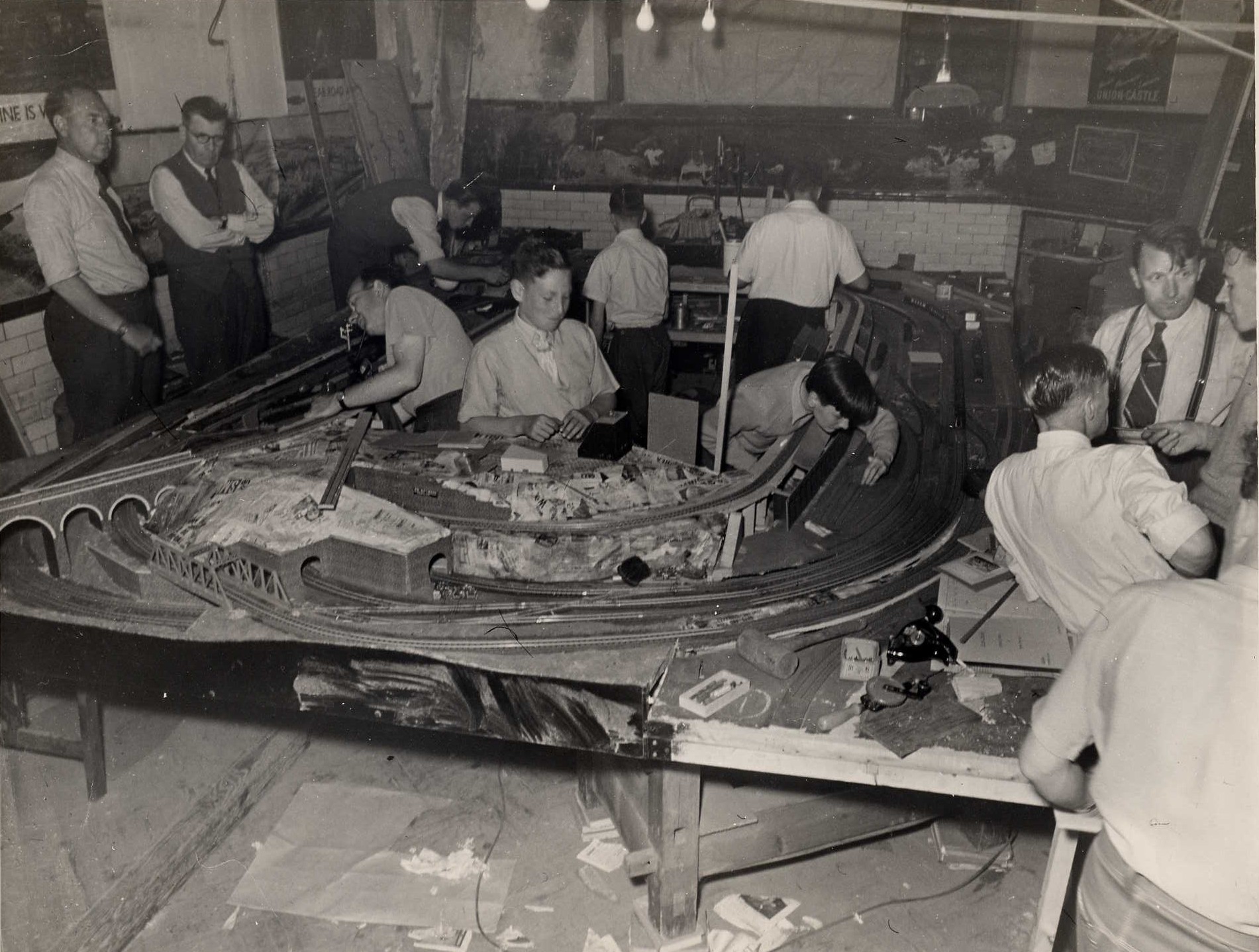
The 1955 exhibition saw the new 00-gauge layout in
operation, albeit without scenery, and the "Maid of Athens", as the
club 5"-gauge loco had been named, was coping admirably with the passenger-hauling
duties on the portable track. This exhibition also began what was to become a tradition
for a few years - the opening ceremony was performed by the star of the summer
show at the Weymouth Pavilion. In 1955 the comedian Derek Roy officiated and a
picture of him at the controls of the model railway appeared in the local
press. Among the celebrities who opened subsequent exhibitions were Charlie
Drake and Bill Maynard - the latter enjoying a spell at the regulator of the
steam loco on the portable track.
With such a large model railway to be transported to
the exhibition site every year, plus all the live steam equipment, when the
opportunity arose to purchase a
To raise extra cash for the model railway group's
projects, additional exhibitions were held in December for three years in the
original venue ~ the small Sidney Hall - to capitalise on the appeal of model
railways at Christmas time. These proved very popular with the
The live steam members were also looking ahead
towards having a permanent, continuous track somewhere in the area. Fortunately
we had as our President the Weymouth Borough Surveyor, the late A J (Jeff)
Wallis, and he gave us much help by suggesting and surveying potential sites.
Unfortunately none of these came to fruition but, eventually, a site at Yeates Corner on
This enabled the live steam group to begin the design
and construction of the components of a permanent track to be laid at Yeates Corner. This was an egg-shaped loop of multi-gauge
track raised on concrete plinths (yes - more concrete mixing!) although this
time the gauges were 3½", 5", and 7¼", the smaller 2 ½"
being left out as the trend by now was towards making larger-scale models and
the ½"-scale, 2½"-gauge models were becoming extinct. The track gave
a continuous run of 400 feet and on completion we welcomed visiting members of
many other model engineering societies to the opening day in 1967.
With the opening of the permanent steam track on
Portland the distance between it and the clubroom at Red Barracks, Weymouth,
was an inconvenience when it came to storing locomotives, fuel and other
equipment after a running session and it was felt that the live steam group
should look for suitable accommodation on Portland, as near to the track as
possible. In due course a shed was found off
From this point the activities of the two branches
tended to diverge somewhat. The Portland Branch concentrated on weekend running
on the permanent track and attending local fetes and rallies with the portable
track. The construction of another steam locomotive was begun in the new workshop
- a 7¼" gauge adaptation of "LBSC's"
"Juliet", an outside-cylindered 0-4-0 tank loco – a simple but rugged
model, admirably suited to heavy duty on the permanent and portable tracks and easy
to maintain. This model was built as cheaply as possible, and no castings were
employed - everything was fabricated from basic raw materials, even the
cylinders. The proof of the pudding was in the eating, and this loco is still
in active service after 25 years! In this time it has seen service all over
The Weymouth Branch now concentrated on the
construction of the new 00-gauge model railway 16 feet by 9 feet in size, with
tracks on three levels. Designed to be easy to erect it had six baseboards each
with built-in legs and it could be erected by three persons and in operation
within two hours of delivery to an exhibition site. In the meantime the first
layout had been dismantled and we had no layout for exhibition duty in the
mid-1960s. Fortunately, by this time we had a good working relationship with
the
The Weymouth Branch had already been helping out at
exhibitions staged by the
By now (early 1966) the Army had transferred Red
Barracks to the Post Office, who used the premises as the local base for the
telephone engineers- department and parking accommodation for its fleet of
vehicles while the new
This new landlord coming to the barracks turned out
to have another advantage .an old Post Office 2-ton parcel delivery van was
parked in the barrack square for some months and, after a few discreet
enquiries, it was found to be on the disposal list. The Weymouth Branch put in
a bid for the vehicle and, in September 1966, became its proud owner for the
sum of £25. This van was ideal for carrying the new exhibition model railway,
and suitable racking was designed and installed so that the whole of the layout
and its associated equipment could be fitted into the van, enabling one journey
to deliver the layout to any exhibition. With the acquisition of this new
transport the Weymouth Branch was able to present its model railway at
exhibitions further afield and, together with
Although the two Branches of the Society now led
separate existences, they came together on numerous occasions when a large
turnout of staff was needed, such as when the portable steam track had to be
manned for an intensive session at fetes, rallies and, in particular, at Weymouth
Carnival, and members of the Weymouth Branch were not averse to getting their
hands dirty on the steam locos. Conversely, certain members of the Portland
Branch had been seen at the controls of the model railway at exhibitions to give
the Weymouth Branch members a break. During the 1960s, with the advent of club
transport, vehicle maintenance had been added to the activities of the Weymouth
Branch and some of the younger members served an apprenticeship that they had
not anticipated when they joined the Society! One young member, in fact, became
so keen that he built his own car, based on an
The Portland Branch, having equipped its workshop
with a wide selection of old but serviceable machine tools, including a 5"
Holbrook lathe and a full-size universal milling machine, now offered excellent
facilities and numerous projects were undertaken by its members. A 7¼ “gauge
freelance model of a BR diesel shunter was built
around an old Royal Enfield 125cc motorcycle engine to share track duties with
"Juliet". The portable track had been rebuilt some time ago and now
was a around level track of only two gauges, 5" and 7¼", instead of
its original format of 2½",3 ½" and 5" gauges raised about 15" above
ground. This rebuilt track was much easier to transport and was now some 120
feet in length.
Another blow to the Society came in 1970, when it was
announced that
1971 coincided with the 400th anniversary of the
granting of
1975 saw another body blow dealt to the Society,
however, when the Post Office gave the Society notice to quit the guard room
prior to the barracks being sold for redevelopment. Interest in the development
of the model railway had been waning for some time, since the cessation of exhibitions
in
In 1991, however, the owners of the Society's
workshop sought an increase in rent that was high enough to cause the members
to question whether the expense of a communal workshop could be justified. At a
special general meeting of the membership it was decided that the workshop was
an expensive luxury which was only being used by a few members and the decision
was made to sell off the Society's equipment and give up the lease of the
premises.
There was a glimmer of hope however, as one of our
newer members was a teacher at the
In the meantime the rump of the club continued to
meet on a Tuesday night in the workshop on
The financial situation within the club was limited
to membership fees only and therefore the prospect of funding any building
activities was very limited. In fact the
club insurance bill ate up most of the annual income. 1998 marked the 50th anniversary
of the club and so members decided that something had to be done both to mark
the occasion and raise some much needed cash. The local museum in
With the active support of the school, the club was
able to establish a rudimentary club house in a disused double garage donated
by the school. A new Technology Block
had just been built and this formed the centre around which was built a ground
level 7¼ and 5" track. This was
back breaking work as the ground was not level and the clay, of the hardest
kind! Nonetheless, after many months of
toil the track was finally completed with embankments, a bridge and a station. The “Wren” and “Juliet” had been returned
from
The “Juliet” did sterling work at weekend on a very rough length of portable track but it earned us much needed cash.
The small but dedicated band of club members then set about digging and cutting the new track bed through impossibly hard clay but eventually a complete loop was achieved around the new technology block.
As we neared completion, news leaked out that the school planned to extend the technology block and half the loop would have to be taken up and re-laid after the extensive building programme. This saw the demise of the embankment and bridge neither of which was deemed a loss as the grass cutting became easier and the new track had a solid 'crush and run' base we pursuaded the builders to leave behind.
So, out with the shovels again but the result was a much longer and very usable track that was more of a challenge to drive than apparent at first sight. The north curve was tightened to a radius of 20' due to the new Sports Hall being placed a few metres out of intended alignment. This, coupled with a gradient of 1 in 30 at one point, would catch out the unwary driver who dared venture up the bank without a full head of steam!
The "Wren" and "Juliet" finally had their own track and in addition to providing the 'non-loco owning' club members a chance to drive, they provided a steady and much needed income on their outings to school fetes.
"Juliet" did sterling work at weekends on a very rough length of portable track which had started life as part of the club track retreievd from the former stone quarry site at Yeates Corner on Portland. This track was eventually replaced with lighter and more easier to assemble portable track in 2005.
Track-moving apart, the move to the College provided a period of welcome stability and mutual benefit during which facilities were added rather than rebuilt or taken away. Permission was granted to use the College workshop, and the Technology Block sprouted a small but heated and lit clubroom which on a cold winter's evening was light-years away from meeting in the garage. The kettle, microwave and loo make us feel very civilised! The garage by now had been relegated to storage duties but no matter how many times it was tidied and re-organised, never seemed to be quite big enough for everything it was required to contain. The track gained a passing loop with station platform and a turntable with steaming bays. An attempt was made to 'beautify' the otherwise sterile environment around the college building with the addition of shrubs most of which survived in the 'hostile' surroundings!
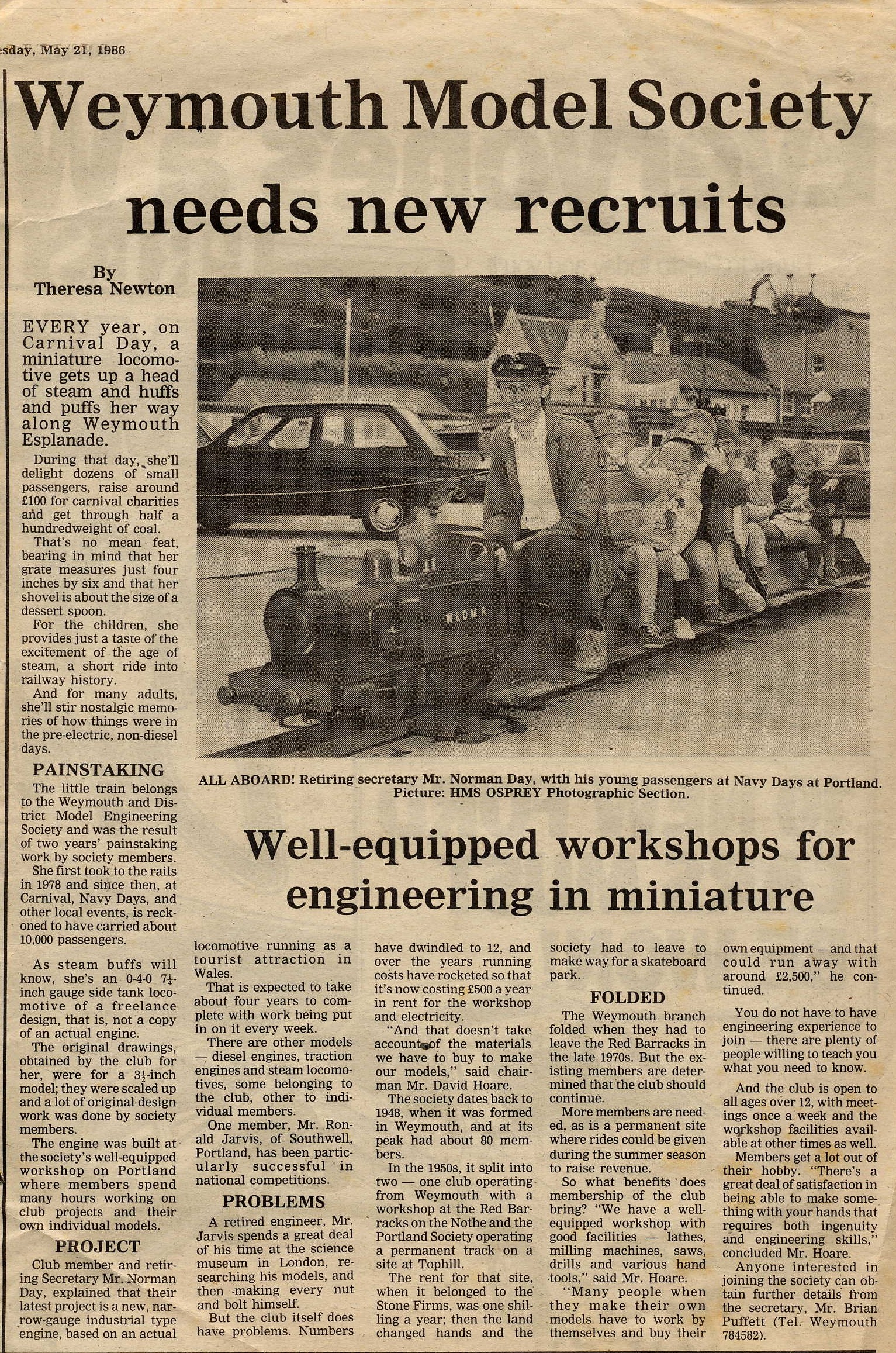
The development of the track brought about a wave of engine building and visitors. Members' projects seemed to get larger and more ambitious, with a large 4"-scale Quarry Hunslet and a Sweet William becoming regular performers and the occasional guest appearance of a Romulus. Nontheless the "Mighty" Wren remained the mainstay of the Club's fund-raising efforts.
By 2007 everything was running as smoothly as a well-oiled Myford. Membership numbers were stable at around 25 and there were regular Saturday steam-ups, plus a full programme of fetes using the portable track. Successful summer barbecues replaced the more formal Annual Club Christmas Dinner.
Another milestone was reached in 2008 with the Club 'Diamond Jubilee'. To mark this occasion the Club once again held a month-long exhibition at Weymouth Museum, Brewers Quay. At the AGM that year, the train well-and-truly hit the buffers again. A new Phase 1 of the College redevelopment programme would mean that half the track would have to be lifted while new building was erected adjacent to it. Uncertainty also existed as to how extensive the redevelopment was going to be and therefore whether the original track could or would ever be relaid. The Club once again entered a period of uncertainty.
The 2009 New Year's Day Steam-up with hot pies and mushy peas was a poignant affair, knowing that it would be the last on that track. And so, mobilising any Club Member who could wield a spanner, push a barrow or make a cuppa, the track was lifted in only a few hours on a cold Saturday just a few days later. The other half of the track remains for the time being, but playing "out-and-back branch lines" has little appeal for the members. The offer by the College of a piece of ground not due for immediate development lead to the calling of a Special General Meeting where a vote was taken to take up this offer and once again prepared to move 'lock, stock, barrel and garage' to an overgrown ex-nature garden once used by the College science department. Age was now taking its toll on members but thanks to the loan of a JCB for a weekend, the overgrown site was cleared in double-quick time. Wood for shuttering, concrete slabs, topsoil and even a concrete mixer have been donated and the first concrete was laid on 2nd June 2009.
2009 also saw the arrival of 16mm guage railway into the Club. Dark cold Tuesday nights in the Club House with nothing to do but to talk about politics lead to the building of a 16mm portable layout that can be used on-site or transported to outside events. While work continued on the modular track boards, several members embarked on in building locos, mainly to ubiquious 'Dennis' or 'Eric' designs. The question remains as to whether we are having a 1954 'deja-vu' moment again, only time will tell.
2011 saw the club move its track within the Budmouth site for the third time as a major rebuild of the school site took place. We were offered a piece of overgrown ground on the boundary of the site well away form the main buildings and alongside a new set of all-weather football fields (see Track page for pictures). At first the site looked very unpromising but after major site clearance activities and with the assistance of a mechanical digger, a trackbed was estabilished. Tracklaying continues into 2012 and it is hoped that by late summer, a full circuit will be in operation.
From this From this
The club also had a clearout of materials including the sale of the club's 7 11/4" Juliet which had been such a mainstay. Without knowing the exact dates but it looks like Juliet has been around since the mid '60s. She has not gone far as she was bought by a club member. The proceeds of all this fundraising allowed the club to buy a new 7 1/4" petrol-hydraulic loco to suport the Wren. Of equal importance, we were able to buy a new trailer for moving the portable track around on. The fear with the old trailer was being stopped by the police becaue it was is such poor condition.
2011/12 also show an increase in membership and with this an increase in activities. As new track is laid other members are refurbishing the rolling stock and the 16mm portable track layout is almost complete. The club is alive and well.
|



.JPG) to
to .JPG)
.JPG) to
to .JPG)
.JPG)